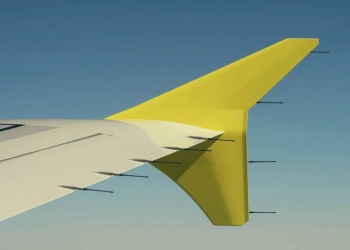
Hello pilots! Today I would like to tell you in more detail why a bend at the wingtip or “winglet” is needed. We will also touch on other methods used to save fuel. This will be a detailed article on this topic, so sit back ;)
Application of winglets
The fact is that during flight, the air flow tends to move from a high pressure zone to a low pressure zone. It flows from under the lower surface to the upper surface through the wing tips, while the flow swirls and forms vortex ropes, the energy the formation of which is called “inductive drag.”
There are 3 ways to deal with this resistance:
— the use of special aerodynamic winglets, which optimizes the flow of flow through them
— application of negative wing twist
— wing extension (also used on MS-21,B777)
Variety of wingtip types
1) In 1985, the European A310 received the first wingtips, the so-called “Whitcomb winglets”. They are also used on the A320, A380 and even on the AN-158, their fuel efficiency is no more than 1-1.5%.
2) At the end of the 1980s, the most common type of winglets, Winglets, appeared. Their fuel efficiency is already up to 3-4%. Installed on B747-400, IL-96, Tu-204, A330, A340, B737NG, B757, B767.
3) Sharklets - the same winglets with a smooth transition, only recently installed on European aircraft. They exist as an option on A320s produced after 2012, and were installed as standard on the new A320neo line. Fuel efficiency reaches 3-4%.
Winglets - why are they needed?, image No. 14
4) Vertical wingtips Raked Wingtips - mushroom wingtips. They first appeared in 1999 on the B767, as well as B747-8, B777, B787. Fuel efficiency is 1.5%.
5) A higher aspect ratio wing is just as effective as using winglets. The greater the elongation, the higher the aerodynamic quality and, as a consequence, the lower the induced drag.
Winglets - why are they needed?, image No. 18
6) Boeing has developed a new type of winglets, unofficially called “double feather” (for the B737max family of aircraft). This two-part ending has one larger part pointing upward and the smaller second pointing downward. It is believed that it represents something in between those used. The acquired savings effect is an additional 1.5%.
Thank you very much for your attention. If you are interested in a similar section, write about it in the comments under the post. If you have any clarifications, please let us know in Group Messages. See you!
Author: Nikolay Shlykov
Edited by: Moisey Khalchen